Growing up in Florida, our only seasons were "hot" and "sometimes not as hot". Since moving to Boston for college, autumn has always been an exciting time of the year. I've been fascinated by the floral biodiversity that expresses even more of a flamboyant personality in the autumn months. And ever since I got into mushroom and tree identification in 2024, I've taken special notice of the funny properties of all of our living friends.
The honeylocust (Gleditsia triacanthos) is a beautiful and bountiful urban tree. You don't normally find them in forests because they have shorter lifespans and struggle for sunlight compared to the taller, shadier forest trees like maple and oak. But because they're so good at dealing with urban stress like pollution, road salt, and root space, you find them popping up all over northern cities. The downside is that they're barren most of the year: they vernate late in spring (mid-April to early-May) and senesce early in autumn (mid-September). As a bipinnately compound-leaved tree, they are a beautiful contrast to our simple-leaved oaks and maples, especially as ash trees decline and black walnuts are scarce.
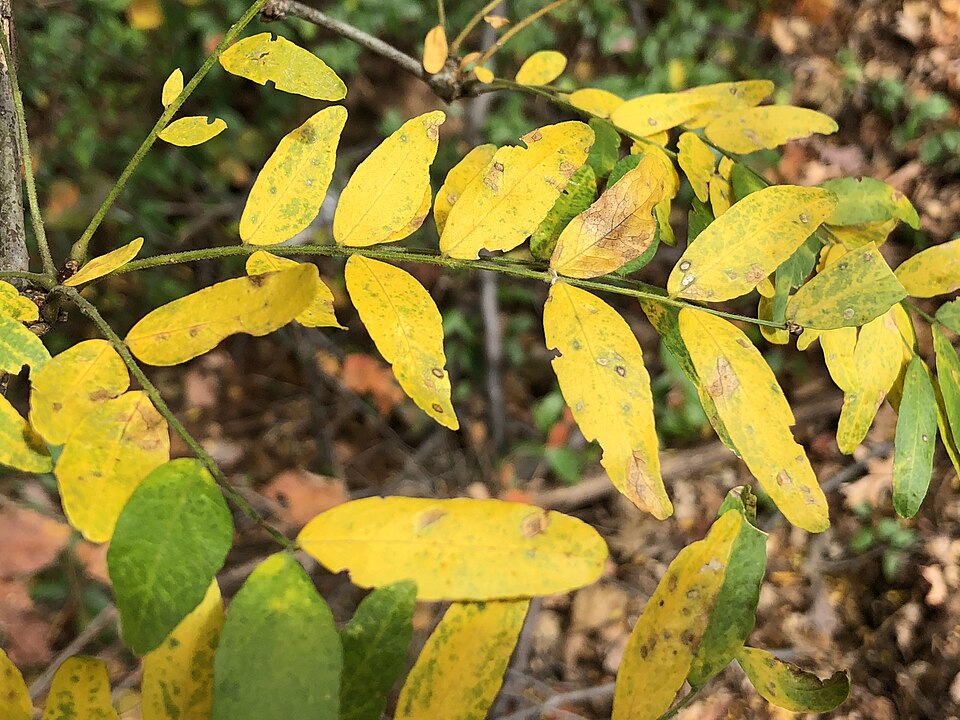 Honey Locust leaves in autumn. Source: Wikimedia Commons

But what caught my attention is their remarkable shiny yellow color that marks the beginning of autumn and showcases a wonderful juxtaposition to the ways that other trees senesce. Maple trees turn a gradient of yellow and red. Oak trees turn brown. Some trees like the pathetic Callery pear tree wastefully drop their leaves while still green. (Which deserves its own article on their interesting early blooming white flowers that mark the start of spring and cause the streets of Boston to smell like dead fish while allowing them to survive spring frosts.)
What I want to talk about is a fascinating property of honeylocust leaves. Whereas other trees tend to form a smooth gradient of senescence across the leaf clusters, honeylocust trees appear a bit more randomly distributed. Sure, you'll find some parts of the honeylocust tree are more yellow based on general sunlight availability and other factors. But within a leaf during early autumn, you'll find most of the leaf still green, but only a few leaflets have begun turning yellow. And once they begin turning yellow, the transition happens in a matter of days. What causes this unusual isolated zoning mechanism?
Senescence and Abscission
Winter is a cruel time of year for plants. Days are short. Water is locked in ice. Nutrients are frozen in the soil. Metabolic processes slow down in winter. It's just not worth it for most plants to fight against the futility of making energy in winter when it turns out you could just hibernate when you know the sun will come back soon.
To deal with this, trees pause most of their expensive processes, including photosynthesis. After all, photosynthesis is such a metabolically expensive operation. But you can't let all those nutrients go to waste. So in autumn, trees sense micro changes in their environment like cooler temperatures and less sunlight to prepare for the winter. Those leaves couldn't survive in winter. Senescence refers to the process where trees break down the compounds in their leaves like chlorophyll to send back to their roots and branches. Abscission refers to the process of breaking off the useless dead weight of these leaves.
When the leaves of trees senesce, the green chlorophyll gets broken down. This leaves them vulnerable to UV damage from the sun. Therefore, trees have underlying compounds to help protect them. The yellow coloring in trees comes from carotenoids like -carotene (which is also the color compound responsible for yellow and orange in fruits and vegetables like carrots and white wine). Carotenoids are long hydrocarbons formed by MEP (the Mevalonate pathway) also responsible for other isoprenoids (terpenoids) like cholesterol, steroids, and vitamin K, forming from the incredible cofactor acetyl-CoA. The red and purple colors come from a class of flavonoids called anthocyanins (also found in red fruit). Oak trees turn brown because their leaves are full of tannins and oils that blend with the yellow carotenoids.
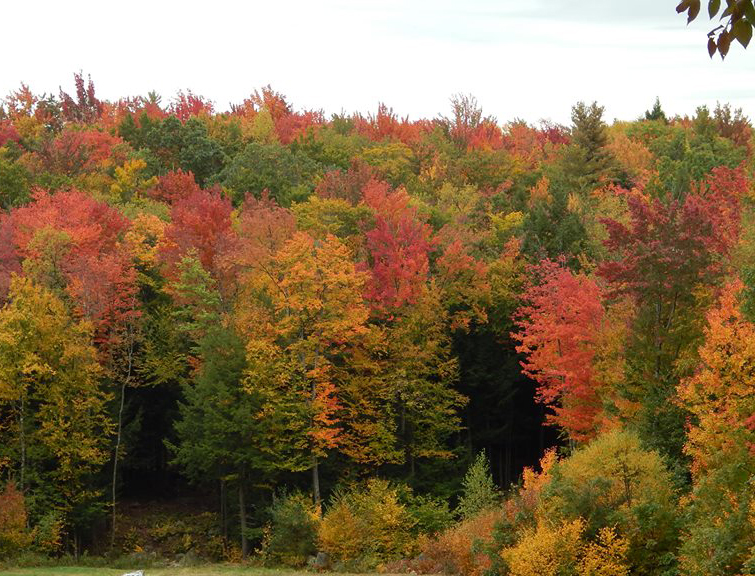 Red maple foliage gradient. Source: Wikimedia Commons

The vascular system in plants consists of xylem and phloem. Xylem is a passive transport system used to carry water (mostly) and nutrients from the roots. Phloem is an active transport system used to carry specific nutrients to plant cells. But during senescence, plant cell walls break down and their stomata become leaky, which would cause water to uncontrollably escape from the cells. Therefore, leaves build up tyloses that block xylem, thereby slowly dehydrating the leaf. Phloem remains to allow the leaf to controllably take in only the nutrients it needs for senescence and abscission, and to send back the nutrients it was able to break down (such as the chlorophyll's nitrogen source).
The Yang Cycle and Ethylene-controlled Transcription
Now we get to the fun biochemistry of how the leaves control this mechanism, allowing us to explain how each leaflet is able to decide whether to begin senescence and abscission.
Biology is full of all sorts of biochemical pathways: series of enzyme-driven reactions from basic, readily-available precursors to complicated, specialized compounds used for all sorts of purposes, from signaling to regulation. Most of these cycles have emerged early in life somewhere between the Cambrian explosion to before LUCA. Over time, domains of life either mutate to break these pathways if they don't need it, or they highly specialize those pathways to re-use them for other purposes. The animal kingdom is notorious for just mutating away these pathways due to their ability to gain essential nutrients from their prey rather than needing to synthesize them on their own. The Methionine Salvage Pathway (MSP) is an excellent example of a pathway found in all life and yet is highly specialized by plants, which is colloquially known as the Yang cycle.
MSP has magical origins tied to life's obsession with SAM (S-Adenosyl methionine). SAM is one of life's most beloved compounds, consisting of a fusion between adenine and methionine. SAM includes a positively charged sulfonium ion which makes it unstable and reactive, desperately throwing away functional groups in an attempt to neutralize the charge. Life used SAM to aggressively donate methyl groups (used in methyl transferases, such as regulating genes via DNA methylation), amino-propyl groups (used to build polyamines), and radical electrons.
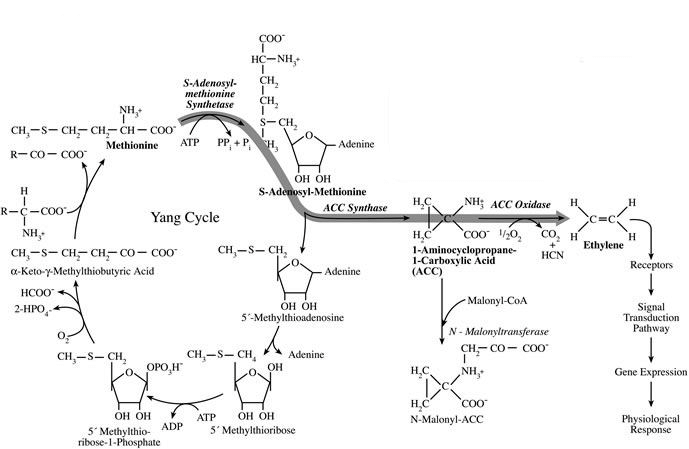 The Yang cycle and biosynthesis of ethylene from methionine. Source: ResearchGate
Despite SAM's usefulness, sulfur is terribly expensive. Thus, life early on evolved to source this sulfur from methionine. And when SAM is used up, life finds a way to revive it as methionine. For example, when SAM is used to methylate, we get SAH as a byproduct. The adenine gets hydrolyzed, giving us homocysteine. Homocysteine gets re-methylated back into methionine. When SAM wants to donate an amino-propyl group to build a polyamine like spermidine, it first de-carboxylates then donates the amino-propyl group, giving us MTA as a byproduct. MTA is then processed in 7 enzyme-driven reactions back into methionine.
Polyamines are useful in most branches of life, especially during DNA replication as their positive charges help stabilize unwound DNA strands. But a plant trying to give up its leaves doesn't need many polyamines. Thus, an enzyme known as ACS (ACC Synthase) skips that process and instead directly gives us MTA (which gets recycled back into methionine) and our important cyclic compound ACC. ACC is then further processed into our plant hormone ethylene. Ethylene ultimately signals a huge cascade of gene transcription to carry out senescence and abscission.
This brings us three intriguing questions we'll address separately.
- How does ethylene signal to the cell it's time for senescence and abscission?
- Why go through all the trouble to build ethylene as our special plant hormone?
- What controls whether the leaf uses SAM to build polyamines or whether to build ethylene?
The Ethylene Gene Cascade
The genetic genome contains countless genes in all life, but the degree at which each gene is expressed is highly controlled via a process known as gene regulation. In positive gene regulation, an activator protein turns on a gene that is normally off by either calling for or helping RNA polymerase transcribe it. In negative gene regulation, a repressor gene binds to DNA to block its transcription, turning a gene off. You can further break down negative gene regulation into negative repressible systems (where a hormone activates the repressor) and negative inducible systems (where a hormone inactivates the repressor).
In eukaryotic cells, positive regulation is much more common due to cell specialization and greater complexity that prefer highly controlled specific gene activation rather than letting most of them run wild. And among negative regulation, negative repressible systems tend to be vastly more common than inducible systems because it's easier to use the accumulation of a hormone to indicate that homeostasis is disrupted.
But ethylene is special in that it's a hormone involved in a negative inducible system. Without ethylene, the ethylene receptors actively fire to activate a repressor kinase called CTR1 (Constitutive Triple Response 1) and EIN2. Here, gene regulation gets a little complicated. But essentially, you have these "captain" repressors called EIN1 and EIN3. When EIN2 lifts these padlocks, the unlocked genes correspond to ERFs (Ethylene Response Factors) which are promoter genes. These ERFs are either repressors of the genes related to senescence and abscission, or are repressors of other ERFs. Regardless, you can imagine a cascade of how the accumulation of ethylene can lead to the expression of thousands of ERFs that are each associated with promoting thousands of genes related to senescence and abscission.
What do these genes do? Some genes express those related to the PAO Pathway, which degrade chlorophyll for its nitrogen, thus degrading the green color of leaves. Some genes transcribe cellulases (which break down cellulose) and polygalacturonases (which break down pectin), thus breaking down the structure of the leaf, eventually causing it to fall off. Some genes help manufacture suberin and lignin, which help build tyloses to block xylem flow and create a scab as the leaf begins to break off. In maple trees, some genes help produce anthocyanins for their red color.
Hormones that Control Ethylene Production
Under normal growth, SAM is used to build polyamines. But when ACC Synthase (ACS) is promoted, SAM instead gets converted into ACC and eventually ethylene. There are a number of hormones that promote ACC Synthase transcription.
Auxins are a class of plant hormones that are abundant in summer. The most important hormone is IAA. When plant cells detect plenty of sunlight and abundant energy, genes are promoted that synthesize more auxins. Auxins can promote Auxin Response Factors (ARFs) which repress ACS promoters. Auxins can also activate ligases that tag stray ACS for destruction such that they only last a few minutes in a summer leaf.
 Indol-3-ylacetic acid skeletal structure. Source: Wikimedia Commons

Auxin production via sunlight levels is a fascinating process. Leaves contain phytochromes which activate in response to red light photons, and de-activate when not hit with red light photons. Thus, there is a concentration of the active phytochrome (Pfr) and inactive phytochrome (Pr). If the plant is detecting lower levels of Pfr over time, that indicates that nights are getting longer, and thus down-regulates the production of auxins.
Abscisic Acid (ABA) is another plant hormone associated with dropping temperature and drought. When temperatures drop, cell membranes become stiffer and more liquid-ordered, which spikes calcium levels, signaling ABA production. ABA up-regulates ACS transcription and closes stomata to conserve water.
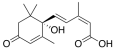 Abscisic acid skeletal structure. Source: Wikimedia Commons

Jasmonic Acid (JA) and Salicylic Acid (SA) are stress hormones related to insect damage and fungal damage respectively. These hormones are produced when detecting certain compounds associated with insect or fungal damage. These hormones bind directly to ACS promoters. This helps the plant dump infected leaves as a form of immune response all year-round, although we do see a spike in autumn as insects and fungi do try to take advantage of the plant preparing for winter.
Thus, environmental factors that signal autumn like sunlight, temperature, water, nutrients, and insect and fungal damage do tell the leaves when it's time to retire and prepare for winter.
Why Ethylene?
Ethylene is a very basic compound, consisting of just 2 carbons bound together by a double bond, with 4 hydrogens. It seems insane for plants to break down the highly useful SAM into a random small compound like ethylene, but there is an evolutionary reason for it.
 Ethene structural formula explicitly showing C and H atoms. Source: Wikimedia Commons

Because ethylene is so small and simple, it's highly volatile and produced by many various organic processes such as forest fires, decomposing soil, and oxidation. Plants first evolved the ability to sense ethylene as a form of immune response to deal with stress factors. Plants evolved an assortment of ERFs that were able to decide when to abandon a part of the plant when too much ethylene accumulates.
Eventually, plants realized that these same genes can be used to conserve energy and nutrients to help it survive harsher conditions like droughts or winters. But you can't just rely on regular ethylene supplies from the environment: you have to deliberately control those levels yourself. And if you decide you want to activate thousands of genes that gamble that dumping all of your leaves and hibernating is actually worth it, you better make sure that your precursor is tightly regulated. With SAM being one of life's most precious compounds, it's hard to find a better contender.
The cool thing about ethylene is thus it's highly volatile and non-toxic. It diffuses into cells very easily, which allows ethylene levels to communicate from cell to cell, and produces no waste as it diffuses out of the cells naturally into the atmosphere.
Conclusion
Every day in autumn, I walk by these honeylocust trees all over Boston and drive through various New England cities. This rabbit hole began with an observation: why do the leaflets turn yellow individually rather than orchestrated all together? And although my focus was on the honeylocust tree in autumn, all of what I talked about applies as a general immune response in all vascular plants, whether in a tundra or a rainforest. Ethylene is highly controlled to ripen fruit, recycle leaves, and respond to flooding, among many other uses.
Honeylocust leaflets are so small and localized that they are incredibly sensitive to hormones like auxins, allowing leaflets to independently carry out senescence randomly throughout autumn. Maple trees, in contrast, have massive leaves and carry out slower senescence. So even though each leaf does decide when to carry out senescence independently, the fewer leaves and slower transition allow maple trees to better coordinate into the stunning gradients we see in autumn.
This deep dive is therefore less about the honeylocust tree and more about exploring a love of botany through a process that has amazed me since moving to Boston. When you grow up in a humid swamp, concepts like falling leaves and snow are foreign, strange, and a bit mythical. And even though the magic of autumn has diminished over the past decade, the questions and curiosity that first sparked in my 18-year old mind have persisted in my memory, which resurface today to give myself a deeper understanding of the world that surrounds me. As I turn off my computer for the night and end this post, I can fall asleep happy knowing that I understand my botanic cousins a bit better, and, for it, I become an even more sincere tree hugger.